
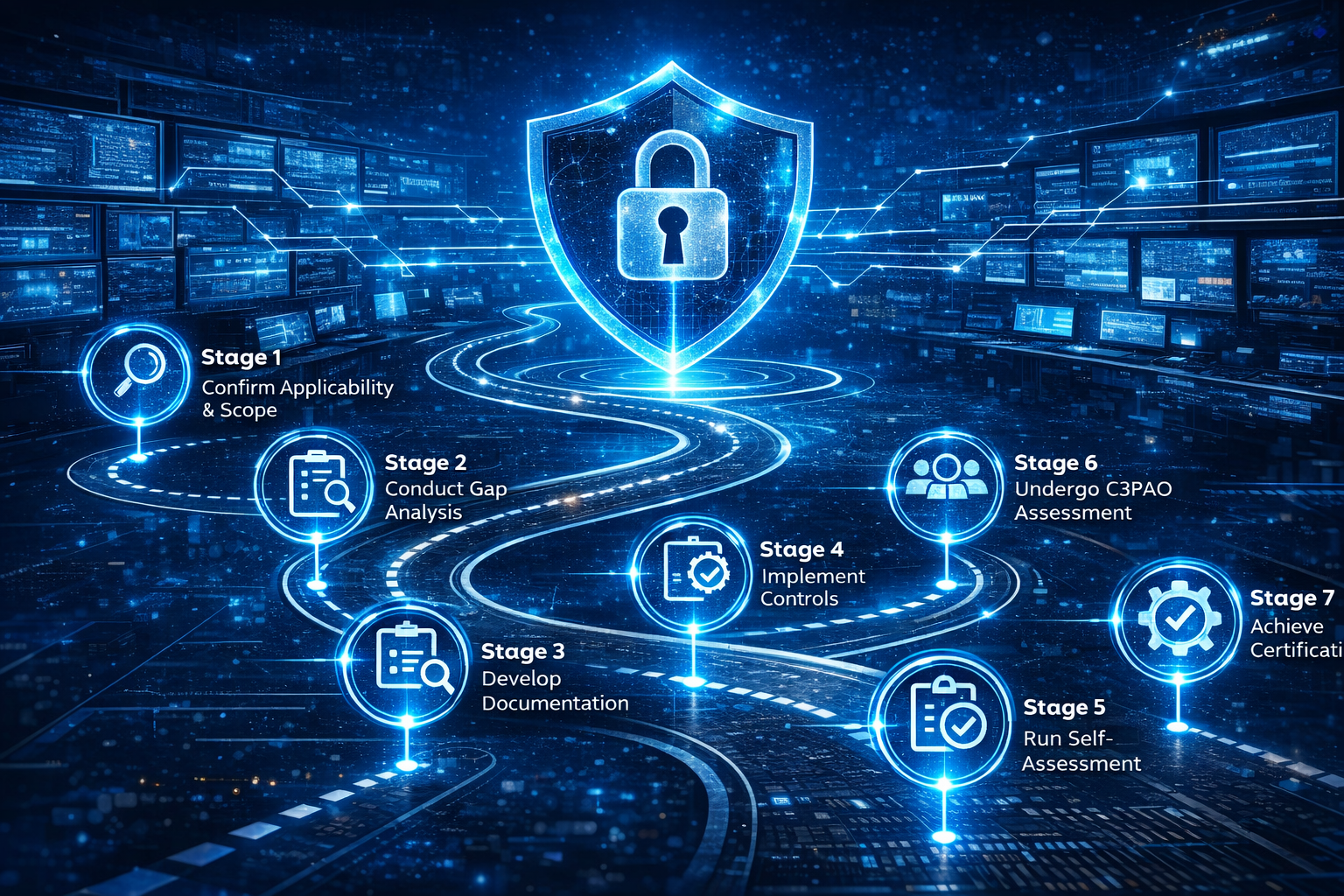
Achieving CMMC Level 2 compliance is now a critical requirement for organizations aiming to maintain or pursue contracts with the Department of War (DoW). Preparation for CMMC compliance can feel like a big undertaking. But when you break it down step by step, it becomes much more manageable. As the roadmap above lays out eight stages, and when followed in order, they form a clear and practical path from scoping all the way to long term compliance.
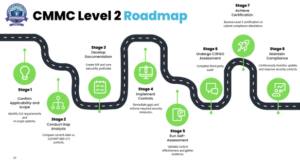
Stage 1: Confirm Applicability and Scope
Every CMMC journey starts by answering two simple questions:
1. Does CMMC apply to us?
2. Which systems and processes are involved?
For organizations handling Controlled Unclassified Information (CUI), the answer to the first question is usually “yes.” Once that is clear, the next step is identifying exactly where CUI flows in your environment. This includes emails, shared drives, devices, cloud services, and so on.
What you are doing at this stage:
· Reviewing contracts to identify CUI requirements
· Mapping out where CUI originates, where it goes, and where it is stored.
· Defining which systems, networks, and staff members are in scope.
· Looking for opportunities to reduce scope (e.g., segmenting systems)
Why this stage matters: You cannot protect something unless you know exactly what you are protecting and where it lives.
Stage 2: Conduct Gap Analysis
Now that you know your scope, the next step is understanding where you stand. CMMC Level 2 requires implementing 110 NIST 800-171 controls, so this is where you compare your current environment against those requirements.
What this typically includes:
· Reviewing each of the 110 controls
· Checking whether you already meet the requirement.
· Identifying missing processes, missing tools, or inconsistent practices
· Prioritizing remediation work based on risk and complexity.
Your findings at this stage become your “project plan” for getting compliant.
Why this stage matters: A solid gap analysis prevents unpleasant surprises later and gives you a clear roadmap of what needs to be fixed.
Stage 3: Develop Documentation
CMMC Level 2 requires significantly more documentation than Level 1, including the System Security Plan (SSP): the core document describing how your organization protects CUI.
Documentation created during this stage may include:
· SSP (System Security Plan)
· Core security policies (access control, incident response, configuration management, etc.)
· Procedures showing how policies are conducted.
· Diagrams of your network and data flows
· Any existing security standards or guidelines
This documentation becomes a key part of your assessment package.
Why this stage matters: Assessors do not just want to see that you have policies. They want to see that you understand your system and have consistency in how you manage it.
Stage 4: Implement Controls
Now comes the hands-on part: actually, fixing the gaps identified earlier. This includes technical, administrative, and physical security enhancements.
This may involve:
· Strengthening identity and access management
· Enabling multi-factor authentication (MFA)
· Implementing endpoint protection and logging
· Improving secure configurations
· Restricting physical access to CUI related equipment
· Training staff on proper handling of CUI
· Deploying tools for monitoring and incident detection
Why this stage matters: This is the step where your cybersecurity posture becomes real and not just documented, but operational.
Stage 5: Run Self-Assessment
Before inviting a Certified Third-Party Assessment Organization (C3PAO) as an external assessor, it is wise to conduct your own internal check.
You will do things like:
· Review each of the 110 controls.
· Validate that your evidence is complete and accurate.
· Evaluate your processes (e.g., access reviews, incident reporting procedures)
· Fix anything that still is not fully implemented.
Many organizations build an “evidence library” here. This will include screenshots, logs, reports, training records, and so on.
Why this stage matters: A thorough self assessment significantly increases your chances of passing the official one on the first try.
Stage 6: Undergo C3PAO Assessment
This is where things get real. A C3PAO reviews your environment, evidence, and practices.
What to expect:
· Interviews with staff (i.e. IT, Marketing, HR, etc.)
· Review of your SSP and policy documents
· Verification of technical controls
· Spot checking configurations.
· Evaluation of security practices and daily operations
It is not just about having policies; it’s about proving that your organization follows them in perpetuity.
Why this stage matters: This is the formal review that decides whether you qualify for CMMC Level 2 certification.
Stage 7: Achieve Certification
Once you successfully complete the assessment and satisfy all required controls, the C3PAO issues a recommendation for certification, and you officially achieve CMMC Level 2.
Why this stage matters: Certification strengthens trust with the Department of War (DoW) and positions your organization for future contract opportunities.
Stage 8: Maintain Compliance
CMMC is not something you do once. It is an ongoing responsibility.
This typically involves:
· Conducting periodic security reviews
· Updating documentation when systems or processes change
· Running refresher training
· Monitoring logs, alerts, and access controls
· Keeping your SSP up to date
· Addressing vulnerabilities as they appear
Why this stage matters: Staying compliant helps you avoid security risks and keeps you ready for reassessments down the line.
Conclusion
The CMMC Journey breaks Level 2 compliance into eight clear stages with each one building on the last. While the process requires effort, following a roadmap step by step makes the journey structured, predictable, and much less overwhelming.